
Plug-in hybrid field study, Energy Policy (2016)
A Field Study of Human Factors and Vehicle Performance Associated with PHEV Adaptation – B.C. Farhar, D. Maksimovic, W.A. Tomac, T.C. Coburn
“Energy and Gender,” Oxford University Press (2014)
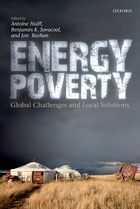
Farhar, Barbara C., Beth Osnes, and Elizabeth A. Lowry (2014). “Energy and Gender,” in Energy Poverty, Global Challenges and Local Solutions, Antoine Halff, Benjamin K. Sovacool, and Jon Rozhon (eds.), Oxford, U.K.: Oxford University Press, pp. 152-179.
This book was reviewed by President Bill Clinton and Mrs. Gro Harlem Brundtland, former Prime Minister of Norway and head of the World Health Organization.
B.C. Farhar, L.M. Hunter, T.M. Kirkland, and K.J. Tierney (University of Colorado-Boulder) “Community Response to Concentrating Solar Power in the San Luis Valley” 2010 NREL/SR-550-48041 June (pdf, 1.1M)
This report is about the social acceptance of utility-scale concentrating solar power (CSP) plants in the San Luis Valley, approximately 200 miles southwest of Denver, Colorado. The research focused on social factors that may facilitate and impede the adoption and implementation of CSP. During the winter of 2008-2009, interviews were conducted with a purposive sample of 25 CSP-related stakeholders inside and outside the Valley. Interviews focused on the perceived advantages and disadvantages of siting a hypothetical 100-MW CSP facility in the Valley, the level of community support and opposition to CSP development, and related issues, such as transmission. State policy recommendations based on the findings include developing education programs for Valley residents, integrating Valley decision makers into an energy-water-land group, providing training for Valley decision makers, offering workforce training, evaluating models of taxation, and forming landholder energy associations. In addition, the SLV could become a laboratory for new approaches to CSP facility and transmission siting decision-making. The author recommends that outside stakeholders address community concerns and engage Valley residents in CSP decisions. Engaging the residents in CSP and transmission decisions, the author says, should take parallel significance with the investment in solar technology.
*Farhar, Barbara C. “Advancing a Market for Zero-Energy Homes.” 2008. Solar Today. 22:1,Jan. Feb. pp. 24-29.
Full report | Solar Today Article (pdf 8Mb)
Dilling, Lisa and Barbara Farhar. 2007. “Making it Easy: Institutionalizing Energy Efficiency and Renewable Energy into Everyday Consumer Practice.” In Creating a Climate for Change, Communicating Climate Change and Facilitating Social Change. Cambridge: Cambridge University Press. Pp. 359-382. (link).
Farhar, Barbara C. and Colleen Fitzpatrick. 1989. Effects of Feedback on Residential Electricity Consumption: A Literature Review. Golden, CO: Solar Energy Research Institute.
* 2008 Recipient of APEX Award for Publication Excellence
Events
The Human Dimension of Plug-in Hybrid Electric Vehicles in Boulder
PHV Study Public Release Presentation (pptx, 27M)
On the Path to Zero-Energy Homes
ZEH Continuum (pdf, 468k)
In the News
Denver Post Business Interview
Zero-energy homes, 2006 to 2008
“Advancing a Market for Zero-Energy Homes.” 2008. Solar Today, 22:1, Jan./Feb., pp. 24-29. pdf (8Mb)
Barbara Farhar and Timothy Coburn, “A New Market Paradigm for Zero-Energy Homes, A Comparative Case Study,” Environment/Science and Policy for Sustainable Development, 50: 18-32. Jan./Feb. 2008.
A New Market Paradigm for Zero-Energy Homes: The Comparative San Diego Case Study
B. C. Farhar and T. C. Coburn, December 2006
Executive Summary (pdf, 105K)
Vol 1 (pdf, 5Mb)
Vol 2 (Appendixes) (pdf, 15.6Mb)
Abstract
We studied the first development of 306 high-performance homes by a production builder in the United States from 2001-2006 using a diffusion-of-innovations perspective. These homes were highly energy-efficient and came with solar water heaters standard. One- third came with 1.2 PV systems standard and buyers could opt for 1.2 or 2.4 PV systems in the remaining PV-eligible homes. The study focused on the builder experience, market response to high-performance homes, increases in home values over time, and the consumption and cost of electricity and gas in the high-performance and adjacent comparison homes. The comparison community of 103 homes was built by a different builder, but was of similar vintage, size, and price. Although built to title 24 standards then in effect, the comparison homes were offered with no special energy or solar features standard. The study addresses the home sales prices, resale prices, the uptake of optional PV systems, the demographics and other characteristics of the home buyers, the role of energy in home purchase decisions, satisfaction, policy preferences, and utility consumption and costs in these homes based on data provided by SDG&E. A new way of thinking about offering new ZEHs is discussed.
Recognition
Dr. Farhar received the Solar Pioneer Award at the World Renewable Energy Congress-IX in Florence, Italy, on August 23, 2006 for her work on increasing the understanding of the human dimensions of energy efficiency and renewable energy, including gender and energy and public opinion about energy.
The West Chamber named her an Outstanding Woman of Jefferson County on November 17, 2006 for her passion for life and her accomplishments in social scientific research and her international work.
She chaired the Technical Committee on Gender-Equitable Development and was a member of the Policies Committee for the World Renewable Energy Congress-X, Glasgow, Scotland, August 2008.